
Markets have always been about buyers and sellers finding each other. In programmatic advertising, an ad exchange does exactly that, but in milliseconds. Through real-time bidding, advertisers compete for your ad space and the best offer wins. In today’s blog, we’ll explain what ad exchanges are, how they work and how they can help you boost your ad revenue.
What is an ad exchange?
An ad exchange is a digital marketplace where advertisers buy and publishers sell their ad space using real-time bidding (RTB) technology.
If you are reading this, you are probably familiar with the ekosystem programistyczny or have heard about technologies like Google Adx. This is an example of an ad exchange. Let’s explore how these platforms make the magic of programmatic happen.
How does an ad exchange work?
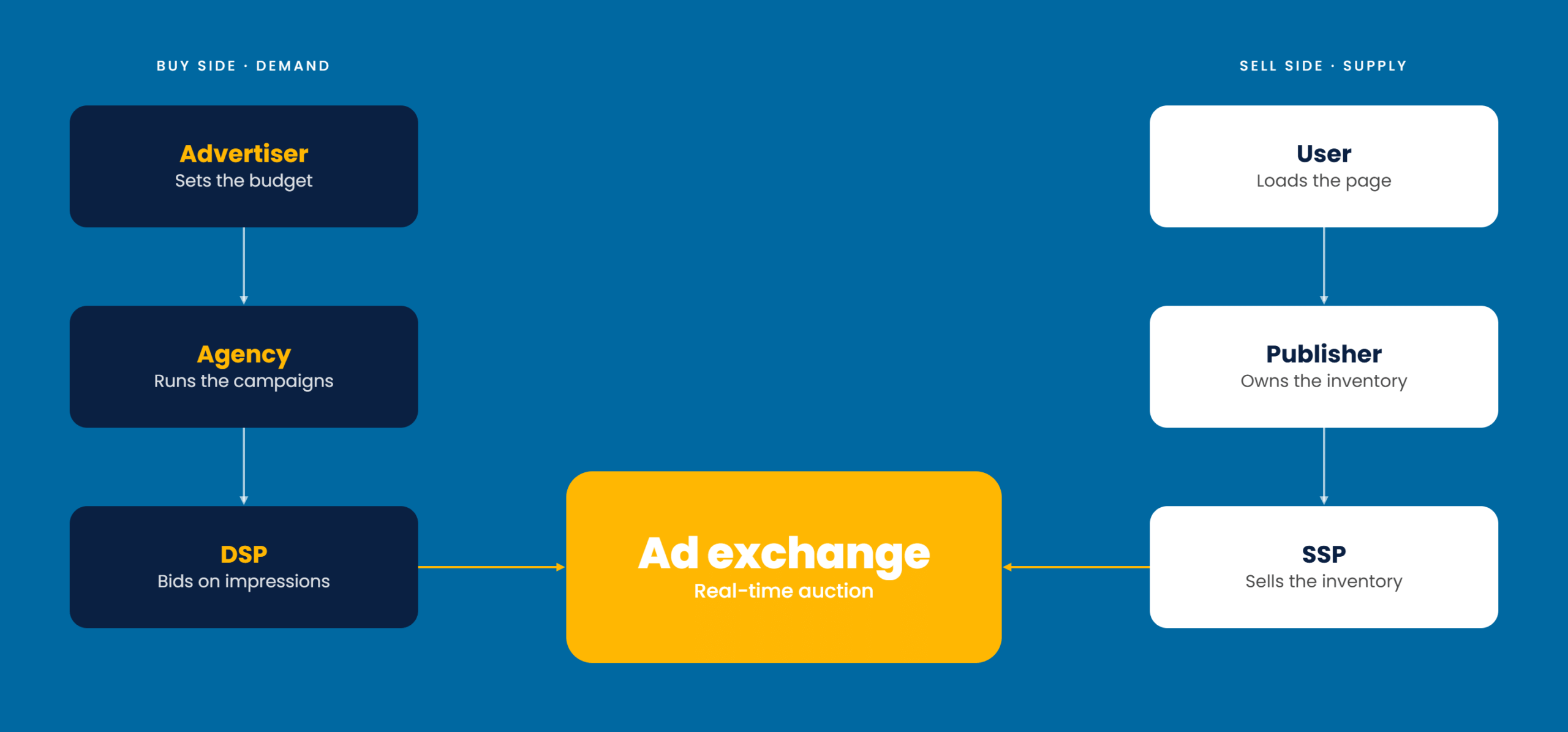
An ad exchange works as a real-time auction. When someone visits your website, it sells your ad space to the highest bidder in milliseconds. To fully understand it, let’s meet the other players first.
Suppose you’re a publisher and you want to earn money creating content on your website. You start thinking, “What if I start selling ad space on it?”.
At the same time, there is an advertiser willing (and eager) to bid on your ad space. Now, how do you both connect to make that happen? This is where DSP i SSPs come in.
A demand-side platform (DSP) is on the advertiser side, and is the one that decides to bid automatically if the ad slot matches with the buyer’s criteria and budget.
A supply-side platform (SSP) is on the publisher’s side. It optimizes your available ad space. How? It knows the details about each ad slot, like placement, size, audience and floor price. The SSP uses all this to sell the space to the highest bidder.
When a user enters your website, the SSP sends a request to the ad exchange, which forwards it to advertisers through their DSPs. The auction takes around 100 milliseconds. That’s literally the blink of an eye. By the time the website has loaded, the ad exchange has already evaluated all incoming bids, and the highest bidder has won your ad slot. Let’s see it with an example.
The programmatic ecosystem through an example
Imagine that you have a football news website, and your cena minimalna (the minimum price you’re willing to sell for) is $1. A user opens up your website to read the Champions League match report the night of the game. You have an empty banner on your website.
These are your bidders:
| Advertiser | Why they’re interested | Bid (CPM) |
| Streaming platform | It is a platform with rights to stream the football match and wants the user to subscribe | $3.80 |
| Sportswear brand | Your readers love sport, so they are more likely to buy sportswear | $2.50 |
| Bank | The bank has a broad targeting, so your website is not the best fit | $0.90 |
The bank is out because its bid is lower than your floor price ($0.90 < $1). The streaming platform wins the ad slot because it has the higher bid ($3.80).
To sum up, here’s the whole process step by step:
- A user opens your website.
- Your SSP sends a bid request to the ad exchange, with details about the ad slot and the user.
- The ad exchange forwards the request to advertisers through their DSPs.
- Each DSP checks if the impression matches its buyer’s criteria and budget. If it does, it places a bid.
- The ad exchange discards the bids below your established floor price.
- The highest bidder wins.
- The winning ad loads on your page.
And your reader never notices a thing.
Examples of ad exchanges
A lot of publishers don’t rely on a single ad exchange. Here are some of the best-known platforms on the market. Keep in mind that apart from Google AdX, most of them are SSPs with their own ad exchange, meaning that they both manage your ad space and run the auction where advertisers bid for it.
- Google AdX: Google’s ad exchange, available through Google Ad Manager. It’s the biggest player in the market, and publishers often access it through a certified partner.
- Magnite: an SSP formerly known as Rubicon Project. It describes itself as the world’s largest independent sell-side advertising platform, and it’s particularly strong in video and CTV.
- PubMatic: an independent SSP that puts publishers first. It’s also one of the companies behind Prebid, an open-source header bidding tool used by many publishers today.
- Index Exchange: a well-known SSP in the header bidding space with a focus on clean and transparent auctions.
- OpenX: an independent SSP that focuses on inventory quality and gives publishers strong control over what’s sold.
Types of ad exchange transactions
There’s more than one way to sell your ad space through an ad exchange. There are different models depending on who can buy it and how the price is set. Let’s look at the three most common types of programmatic transactions:
Open auction
An open auction is an open market where any registered advertiser can bid on your ad space. It uses real-time bidding. When your goal is to maximize your campaign reach, this is the prime option.
Private marketplace
In a private marketplace, the publisher carefully selects the advertisers that will participate in the auction with real-time bidding. Since it’s a more premium inventory, advertisers usually pay higher CPMs. That’s why it works best for high visibility campaigns that require brand safety.
Programmatic direct
In programmatic direct, there is no auction. It’s a one to one agreement with the advertiser, where you both agree on a fixed price in advance. It is best for reliable revenues and predictable costs. It comes in two ways:
- Preferred deals: The publisher doesn’t reserve inventory for the advertiser, but gives them priority to get the ad slot first. If they decide not to buy, the impression goes to auction.
- Programmatic guaranteed: The publisher reserves and guarantees a volume of impressions for the advertiser.
Benefits of ad exchanges
There are advantages for both sides of the programmatic world: publishers and advertisers.
Ad exchange benefits for publishers
- Market-driven pricing: There’s no fixed rate for your ad space. Each impression goes to auction, so its price reflects what advertisers are willing to pay right then.
- More competition: Ad exchanges connect with multiple demand platforms and advertisers. More bidders means more pressure on the price of each ad slot. That usually translates into higher CPMs, fill rates and yield. Not bad, right?
- Control over quality and price: You establish your own ceny minimalne, define brand safety rules and filter advertisers that you don’t want on your site.
Ad exchange benefits for advertisers
- Automation and efficiency: Direct sales work, but they take time. RTB is makes buying instant.
- Transparency: Ad exchange platforms provide detailed reports, so advertisers can track campaign performance and adjust their strategy.
- Wider reach: They give advertisers access to a wide range of publishers with quality inventory.
- Precise targeting: Advertisers can reach the right audience using location, interests, and behavioral data.
In short, ad exchanges make the process of buying and selling ads faster and more transparent, while being highly profitable for everyone involved.
Ad exchange vs ad network: what’s the difference?
If you’ve ever confused ad exchanges with ad networks, don’t worry, you’re not alone. They sound similar, but they work very differently.
An ad network is an intermediary. It buys inventory in packages from publishers to sell it to advertisers. An ad exchange, on the other hand, is an open marketplace where each impression is auctioned in real time. Unlike an ad exchange, a traditional ad network:
- Isn’t a marketplace itself.
- Is especially useful for smaller publishers, who benefit from its scale and don’t need to build their own tech.
- Is often less transparent. Publishers may not know who they sell ad space to, and advertisers may not know where their ads appear.
Want the full picture? Read our guide on the differences between an ad network and an ad exchange.
Ad exchanges: a key to smarter monetization
In the time it takes your reader to blink, an ad exchange has already found the best buyer for your ad space. And the more advertisers compete, the more you earn. However, getting the most out of it takes time and mainly, expertise. That’s where Refinery89 comes in. Ready to get more out of every impression? Get in touch with our team.